



Global shipping faces a growing threat: the shadow fleet. These tankers carry sanctioned oil under flags of convenience or through frequent reflagging, often uninsured and operating outside compliance frameworks. They frequently conduct ship-to-ship (STS) transfers in international waters and employ deceptive tactics such as identity changes (vessel laundering, flag hopping), complex shell ownership structure, or Automatic Identification System (AIS) manipulation.
Shadow fleets are not a new threat to the maritime sector. However since Russia’s full-scale invasion of Ukraine, they now account for 17% of the global tanker fleet. This represents a doubling in size since 2022. Coupled with increased sophistication of mechanisms, this contributes towards the creation of unprecedented risks for the insurance industry.
Where Are These Ships Operating?
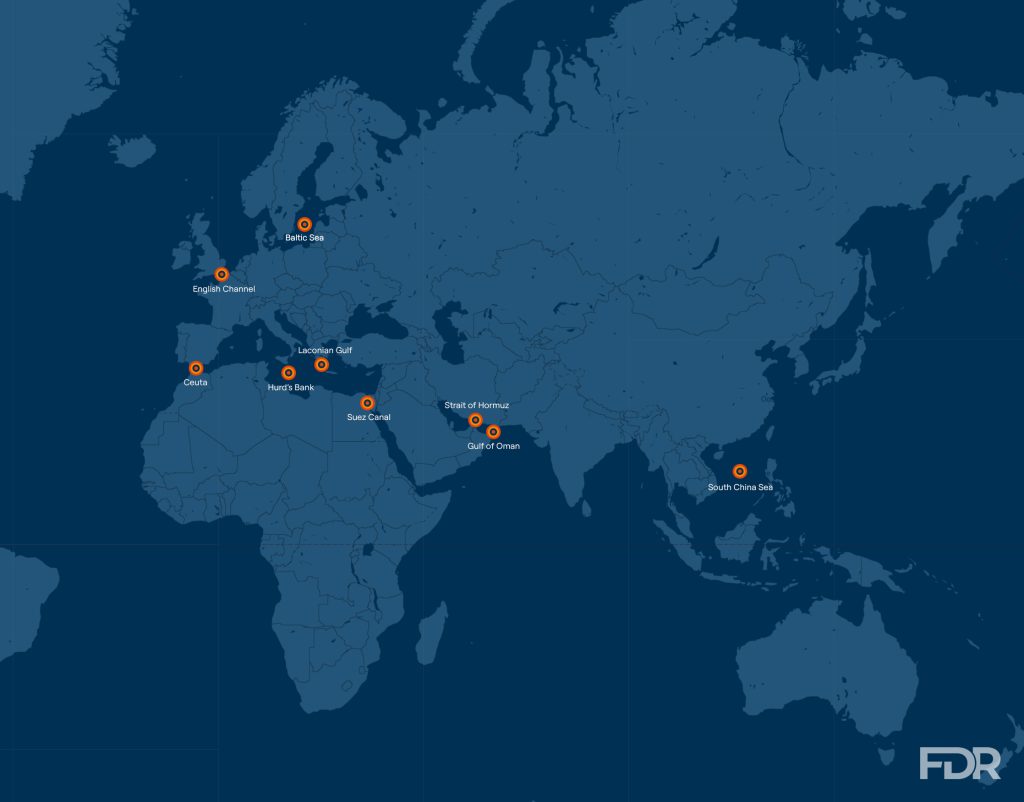
Shadow fleet vessels operate in high-density corridors, sharing space with legitimate traffic in some of the world’s busiest and most strategic routes. In the Mediterranean, STS transfer zones such as the Laconian Gulf in Greece, Hurd’s Bank near Malta, and waters off Ceuta near Gibraltar have become staging points for sanctioned cargo.
Further north, the Baltic Sea and English Channel see increased traffic and congestion as see these tankers moving alongside legitimate vessels. The Suez Canal, a critical artery for global commerce, is particularly vulnerable, where narrow channels leave no room for error when AIS-dark ships transit alongside compliant vessels. Shadow fleet vessels operate across major global trade routes, including the Strait of Hormuz, the Gulf of Oman, and the South China Sea, and amplify navigational complexity.
The Systemic Risk: Collision and Liability
AIS Manipulation: Why It Matters
GPS tells a ship where it is; AIS tells everyone else where the ship is and is a cornerstone of maritime safety. Shadow vessels exploit this system in two ways. First, they engage in “Going Dark” by switching off AIS entirely when entering high-risk zones or during STS transfers, making them invisible to monitoring and collision avoidance systems. Second, they utilise “Spoofing,” broadcasting false coordinates or vessel names to mask identity or location, which undermines enforcement and navigational safety.
The Enforcement Gap: No Registry, No Control
The shadow fleet is not a formal entity; it is a collection of vessels that actively exploits the fragmented international system of ship registration. These vessels frequently engage in “flag hopping” or rapidly switching between flag registries or using false flags to mask their true identity and ownership. This continuous obfuscation makes it nearly impossible for port authorities to stop or detain a vessel based on suspicion alone, frustrating international efforts to hold the ships accountable for their poor safety standards. False flagged ships have doubled in the past year, with at least 18 fraudulent registries linked to the shadow fleet. Additionally, shadow fleets rely on the Law of the Sea “innocent passage” rights and governments avoid provocative interception of ships.
Compounding these risks, many vessels operate under falsified registrations and skip mandatory inspections, lacking certificates required by international conventions. Ageing hulls and poor maintenance increase the likelihood of mechanical failures and catastrophic accidents. With the fleet expanding and maintenance standards deteriorating, the probability of incidents continues to rise.
How Likely Is a Collision?
Allianz’s Safety & Shipping Review 2025 reports more than fifty major incidents involving these tankers over the past three years, ranging from fires and groundings to direct collisions. These ships also disclose false port calls, or travel on circuitous routes such as transiting around the Cape of Good Hope when travelling between Asia and Europe, adding 40% more time to the journey time.
On October 28, 2025, the Russian shadow fleet tanker Komander suffered an engine failure and ran aground in the Suez Canal, briefly blocking one of the world’s most critical trade routes. In December 2024, two ageing Russian tankers broke apart during a storm in the Kerch Strait, spilling up to 8,500 metric tons of heavy fuel oil into the Black Sea. Similar spills in Europe have an estimates cleanup cost of US$8,595 per tonne. This means this incident alone could cost US$20–$73 million, excluding environmental and legal liabilities.
The Liability Nightmare: Who Pays?
These ships operate without valid P&I cover or rely on obscure insurers outside recognised frameworks, leaving certificates that are often meaningless. At one point, a small New Zealand insurer covered nearly one-sixth of these tankers, enabling billions in sanctioned oil trades before withdrawing, proof of how easily liability disappears into a legal black hole.
When a collision occurs, the costs fall on compliant shipowners or coastal states. The compliant shipowner’s insurer (i.e., the P&I Club) will pay out the claim, but their subsequent right to subrogation—the legal mechanism to recover costs from the liable third party—is instantly nullified. This forces the insured party and their underwriters to bear the full expense. The costs are staggering and recovery is slow or impossible due to shell ownership structures and jurisdictional limits beyond twelve nautical miles. Each accident adds to a growing financial burden as the shadow fleet expands and ages.
As such, shadow fleet incidents are not simply a regulatory concern; they represent a material financial and reputational risk. Shipowners must take proactive steps including screening counterparties for sanctions and genuine P&I cover before any STS transfer or chartering. Operators need to review their own P&I limits and consider additional protection for pollution and collision liabilities. Operators should carefully plan routes through high-risk transfer zones and congested corridors and maintain due-diligence records to safeguard against future disputes. For insurers, the priority is tightening underwriting standards, verifying vessel histories and flag changes, and refusing cover where compliance cannot be proven. Enhanced monitoring of AIS manipulation and sanctions evasion should become part of risk assessment.
Recent Developments: Enforcement Is Catching Up
The regulatory landscape is shifting fast. Since April 2025, the EU has enforced mandatory provision of insurance, with 20% of vessels being non-compliant. In November 2025, the EU began discussing its 20th sanctions package, which includes stricter measures against shadow fleet vessels and automatic blacklist updates. More than 550 ships are now under sanctions, and the latest package adds 117 more vessels. The EU has banned refueling at ports from January 2026. The UK also issued an Amber Alert warning maritime and financial institutions about shadow fleet evasion tactics.
With enforcement tightening and geopolitical tensions rising, the shadow fleet is not just a sanctions story; it’s a systemic risk to global shipping. It will keep growing, but you can decide how exposed your balance sheet is.
Aligning Coverage with Reality
Shipowners, charterers, and brokers who take this risk seriously must move from awareness to execution. That means mapping exposure corridors where legitimate vessels share water with shadow fleet hotspots and building this into routing and risk appetite decisions. Sanctions screening, AIS anomaly detection, counterpart due diligence and charterparty clauses should operate as one integrated control system, not disconnected tick-boxes. Liability limits and pollution cover must be recalibrated against realistic scenarios, not historic averages, because spills in the billion-dollar range are no longer tail-risk, they are live possibilities.
P&I, Hull & Machinery and charterers’ liability should be stress-tested for collisions involving uninsured or fraudulent counterparties, and crisis playbooks agreed with insurers before an incident, not improvised in the first 48 hours of a spill. Insurance cannot neutralise the shadow fleet, but it can decide who is left holding the bill and how survivable that bill is.
FDR ensures you are not the compliant shipowner subsidising the worst-run tanker. We align your insurance programme with real trading patterns, engineer structures that survive sanctions scrutiny, close contractual gaps others ignore and pre-agree crisis pathways, so you know exactly who does what when the bad day comes.
Contact us today to start a conversation about securing your fleet’s future.
