



At its core, Charterers’ Liability (CL) insurance protects charterers against liabilities arising from their role in the use and commercial employment of a vessel.
Most charterers still purchase insurance as if their exposure begins and ends with cargo damage. In reality, that assumption fails to reflect how liability arises in modern chartering operations. Under many legal systems, charterers can be treated as carriers, with corresponding responsibilities and liabilities. Even where liability is disputed, the cost of defending a claim can be material in its own right.
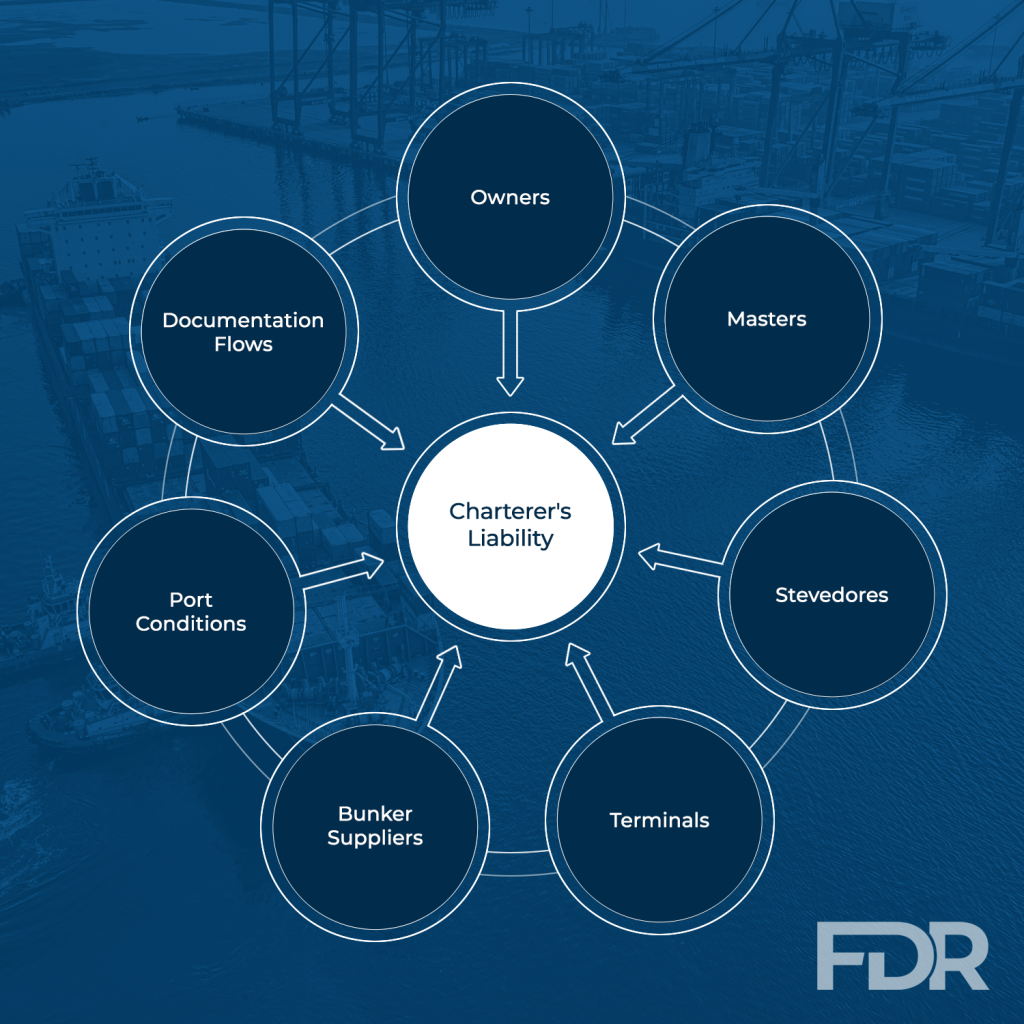
The structural issue is straightforward. Charterers sit in the middle of a liability chain they do not fully control. Owners, masters, stevedores, terminals, bunker suppliers, port conditions, and documentation flows all sit around the charterer. Yet when something goes wrong, the charterer is often the first party drawn into the claim. Operational excellence by others may reduce the likelihood of loss, but it does not prevent exposure once liability is alleged. CL Insurance exists precisely because this middle position creates risk that cannot be fully transferred contractually.
The Middle Position No One Can Contract Away
It is important to remember that CL Insurance extends far beyond cargo claims. Depending on the structure and wording, a charterer may face liability for physical loss or damage to the chartered vessel, including detention or loss of use following vessel damage. Exposure can also arise in respect as a result of cargo damage or misdelivery, collision liabilities, third-party property damage, pollution incidents, wreck removal, quarantine expenses, general average contributions, fines, enquiry expenses, and interference by government authorities.
These liabilities arise not because charterers control the operation, but because they sit at the contractual centre of the transaction. When losses occur, liability frequently follows contractual responsibility rather than operational fault. In practice, that means charterers can be drawn into claims even when the underlying incident was caused elsewhere.
A significant proportion of cargo damage claims arise from cargo handling operations, where charterers are often drawn into liability through contractual arrangements. Hull damage claims are also disproportionately concentrated in port, where berth safety, terminal conditions, and stevedore activity create exposure that charterers may inherit through charter party obligations.
Why Legal Spend Is a Liability in Its Own Right
One of the most underestimated aspects of CL Insurance is defence cover for legal costs. Once a charterer is drawn into a cargo, vessel, pollution, or third-party liability claim, legal expenditure can escalate quickly across jurisdictions, particularly where multiple contracts, counterparties, and insurers are involved.
Even where a charterer ultimately succeeds in minimising liability, the cost of defending the position can erode margins, strain working capital, and divert management’s resources. Defence costs should therefore be viewed as a core exposure rather than a secondary consideration for charterers, particularly for those operating across multiple jurisdictions.
Owner Insurance Protects Owners—Not You
A common misconception is that the owner’s protection and indemnity or hull and machinery insurance programme will absorb losses arising during a charter. While those covers protect the owner, they do not prevent owners, cargo interests, or third parties from pursuing the charterer directly. Owner insurance responds to the owner’s liabilities first, and this does not protect the charterer’s balance sheet. As such, treating owner insurance as a safety net for charterer exposure is a structural mistake.
CL Insurance is a product designed to respond to the charterer’s own contractual and thirdparty liabilities, including liabilities to the owner for vessel damage where the charter party allocates responsibility accordingly.
The Gaps Most Charterers Still Miss
The most significant gap in many CL placements is not the absence of cover, but the lack of alignment between insurance, contracts, and operations. Charterers often assume that liabilities arising under charter parties, side letters, or operational agreements are automatically covered. In reality, liabilities created solely by contractual terms or indemnities may fall outside cover unless they have been specifically approved.
Bespoke indemnities, non‑standard charter party clauses, unusual cargo undertakings or side agreements with terminals or service providers can all create silent uninsured exposures. Claims handling discipline is another frequently underestimated risk. Policy conditions typically require prompt notice, timely document production, and restrictions on admissions and settlements. Poor post‑event handling can jeopardise recovery even where the underlying claim would otherwise have been covered.
War risk, sanctions, and restricted trading also require active attention. War cover for charterers is usually subject to its own conditions, exclusions, and cancellation mechanics. Unless specifically agreed, liabilities arising from trading to or from certain areas may be excluded, and sanctions clauses can further restrict recovery. For charterers operating in geopolitically sensitive trades, these are not background issues.
For freight forwarders and brokers, this marks a clear shift in exposure. Carbon can no longer be treated as a regulatory side issue. It is emerging as a financial risk category in its own right, one that must be managed in much the same way as fuel costs, currency risk, or movements.
From Optional Spend to Core Risk Management
CL Insurance is not a blanket solution, and it is not without limitations. Contractual liabilities may require prior approval, certain cargoes, or specialist operations may be restricted, sanctions can block recovery and poor claims conduct can adversely impact cover.
The real question for charterers is whether their CL structure reflects how their business actually operates: how contracts are written, trades are executed, claims are handled, and geopolitical risk is managed. CL should be treated as core trading infrastructure rather than an optional expenditure line item. In practice, the largest uninsured exposures are often created not by the casualty itself, but by assumptions that someone else’s insurance, or a generic placement, will respond to liabilities created by a charterer’s own contracts and operations.
